
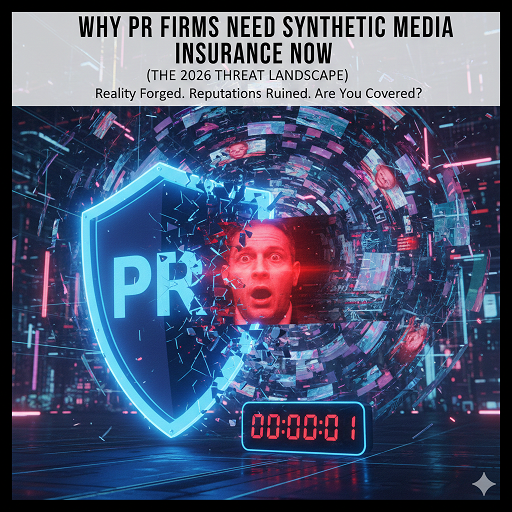

The conversation around Synthetic media insurance has moved from speculative fear to immediate operational necessity for PR firms globally.
As deepfake technology becomes cheaper, faster, and frighteningly realistic, the inherent risk profile of public relations agencies has undergone a seismic shift. If your agency handles high-profile clients, manages sensitive political campaigns, or simply creates significant volumes of digital content, you are now a primary target.
This isn’t just a matter of improving your firewalls. This is about protecting your agency’s entire existence against malicious, digitally fabricated reality.
Why PR Firms Need Synthetic Media Insurance Now (The 2026 Threat Landscape)
We are entering an era where reality is easily forged. A highly polished deepfake video—showing a CEO making a damaging statement or a celebrity endorsing an illegal product—can be created in minutes and distributed globally in seconds.
For PR firms tasked with guarding reputation, this speed is lethal. Traditional crisis management response times simply cannot keep pace with the velocity of disinformation campaigns.
This escalating danger necessitates proactive reputation risk mitigation 2026 strategies. Waiting until a crisis hits is no longer feasible; the damage is often irreversible before the truth can be established.
The liability doesn’t just rest with the creator of the deepfake. If your firm, even inadvertently, shares, fails to detect, or mishandles the response to a deepfake targeting a client, you face massive litigation.
The cost includes legal defense, forensic investigations to prove fabrication, and the monumental effort required to restore public trust. Without specialized coverage, these costs can bankrupt even large agencies.
Understanding PR Agency Professional Indemnity in the Age of AI
Many firms believe their standard Professional Indemnity (PI) policy offers adequate protection. Unfortunately, most traditional PI policies were written before generative AI became mainstream.
These older policies often contain critical exclusions related to libel, slander, or defamation arising from digital forgery or synthetic content.
The definition of covered error or omission needs to explicitly encompass the failure to detect a deepfake or the unintentional publication of AI-generated misinformation.
If your policy doesn’t explicitly mention coverage for digital forgery or manipulated content liability, your PR agency professional indemnity is likely insufficient for today’s risks.
The Rising Cost of AI Liability Premiums
Insurers are quickly catching up to the risk, and this means AI liability premiums are climbing steeply. The pricing is no longer based solely on your revenue or client size, but heavily on your firm’s internal technology stack and risk controls.
Carriers are scrutinizing how agencies use AI internally. Do you utilize tools for image or content creation, and if so, what are your provenance and verification processes? (If you are leveraging AI tools, make sure you know which ones are safe, like those reviewed in Best AI Tools in 2026: 11 Insane Apps for Amazing Success).
The higher the potential for the firm to accidentally generate or disseminate harmful content, the higher the premium. This means internal governance around AI usage is directly tied to the cost of your insurance.
Furthermore, insurers are looking closely at sectors. Agencies dealing with finance, government, or high-stakes corporate mergers face significantly higher premiums due to the lucrative target they present to bad actors using deepfakes for market manipulation.
Distinguishing Deepfake Risk from Standard Cyber Insurance for Media Agencies
It’s crucial to understand that AI deepfake liability is distinct from traditional cyber risk. Standard cyber insurance focuses on network security, data breaches, and ransomware attacks.
Deepfake incidents, however, are fundamentally content-based risks. They deal with defamation, intellectual property theft, brand dilution, and market manipulation, not just data theft.
While standard cyber insurance for media agencies is vital for protecting client data and internal systems, it typically does not cover the legal costs associated with proving a media asset was fabricated or the massive reputation repair costs.
Synthetic media insurance specifically addresses the financial fallout from digital content manipulation, offering coverage for specialized legal teams, public relations crisis consultants, and forensic analysis needed to prove fabrication in court.
The Ultimate 7 Steps to Securing Synthetic Media Insurance Coverage
Navigating this new insurance landscape requires a structured approach. Simply applying for a policy won’t suffice; you must demonstrate rigorous control over your digital environment.
Step 1: Conduct a Comprehensive AI Risk Audit
Before speaking to a broker, you must quantify your exposure. Inventory every piece of generative AI software used by your team, from internal coding assistants to image generators.
Assess which clients are most vulnerable to deepfakes (e.g., highly recognizable faces or publicly traded companies). Use this data to determine your worst-case exposure scenario.
Step 2: Establish Strict AI Governance Protocols
Insurers demand proof of control. Implement a mandatory, documented policy covering the creation, verification, and distribution of all AI-generated content.
This policy should include clear rules on utilizing watermarking technologies or provenance metadata, making sure your team understands the legal implications of synthetic content. Understanding the nuances of tools like Gemini is key to safe usage (See: Decoding the Google Gemini Models: Which One Should You Actually Use?).
Step 3: Mandate Deepfake Detection Training
Human error is often the weak point. Train your content review and legal teams to recognize the subtle, and increasingly less subtle, hallmarks of deepfakes.
This training should be continuous, as detection technology evolves almost monthly. Your readiness is a key factor in reducing your overall premium.
Step 4: Secure Expert Legal and Broker Consultation
Do not rely on a general insurance broker. Seek out brokers and legal counsel specializing in media liability, technology errors and omissions (E&O), and emerging AI risks.
They can help you structure layered coverage that integrates your existing PI and Cyber policies with the new specialized synthetic media insurance.
Step 5: Negotiate Coverage for Reputational Harm Costs
Unlike standard policies which focus on legal defense, true deepfake coverage must include funding for crisis PR. The immediate need after an attack is often reputation repair, which is expensive and time-sensitive.
Ensure your policy covers retainer fees for specialized crisis communications firms brought in specifically to counter the deepfake narrative.
Step 6: Implement Robust Verification and Provenance Systems
Adopt technologies that track the origin of every digital asset used in your campaigns. This “digital fingerprinting” is essential for quickly proving in court that a genuine asset was tampered with.
The ability to instantly verify the integrity of your media is your best defense. For more on ensuring authenticity when creating assets, review tips on The Latest AI Photo Generation Prompts You Need to Try.
Step 7: Update Client Contracts and Indemnification Clauses
Your client contracts must reflect the shared risk of the deepfake era. Clearly define responsibilities for content verification and liability limits related to externally fabricated media targeting the client.
A transparent contractual relationship reduces the chance of expensive client litigation against your firm after an incident.
How Synthetic Media Insurance Handles a Deepfake Crisis
When a deepfake hits, the clock is ticking. Synthetic media insurance acts as a rapid response financial backstop.
First, it immediately mobilizes funds for forensic IT experts needed to analyze the fake content and determine its source and characteristics. This digital proof of fabrication is essential for legal recourse.
Second, it covers the extensive legal defense fees required to pursue cease-and-desist orders, defamation suits against the distributors, and counter-litigation if the firm is sued by the client or shareholders.
Finally, and most crucially, it provides dedicated funds for reputational rehabilitation, covering the high costs of advertising, media placement, and consulting required to drown out the disinformation campaign.
This specialized coverage understands that time lost is reputation lost, making rapid financial mobilization the primary benefit.
Future-Proofing Reputation Risk Mitigation 2026 and Beyond
The landscape of deepfake risk is not static; it is accelerating. As AI models become faster, the difference between a real video and a fabricated one will become indistinguishable to the naked eye. Regulation around deepfakes is rapidly evolving globally, adding complexity to compliance.
Effective reputation risk mitigation 2026 requires PR agencies to view insurance not as a cost center, but as a strategic investment in business continuity.
The future of PR liability will likely involve mandatory AI disclosure laws, requiring agencies to certify that content they produce is genuine or clearly marked as synthetic.
Agencies that fail to adapt their insurance and governance structures now will be critically exposed when the inevitable deepfake crisis hits their client base. Protecting your firm means understanding that digital content is now a potentially catastrophic liability.
Is Your Agency Protected? The Rise of AI Deepfake Liability Insurance for PR Firms
Imagine it’s 2:00 AM. A video of your agency’s biggest client—a Fortune 500 CEO—is going viral. In the video, they are making disparaging remarks about a sensitive political issue. It’s a deepfake. By 6:00 AM, the client’s stock is down 8%. By 9:00 AM, the client is suing you for failing to secure their digital likeness.
In 2026, this isn’t science fiction—it’s a Tuesday. If you haven’t secured AI Deepfake Liability Insurance for PR Firms, you are operating without a safety net in the most dangerous media environment in history.
Why Traditional Professional Indemnity is Failing in 2026
For decades, PR agencies relied on standard Professional Indemnity (PI) or Errors and Omissions (E&O) insurance. But these legacy policies have a massive blind spot: Synthetic Media.
Most 2026 insurers now include “Algorithmic Exclusion” clauses. This means if a crisis is sparked by AI-generated content, your old policy might be void. Modern Cyber Underwriting now requires specific riders to cover the “Reputational Fallout” of a deepfake attack. Without these, your firm is personally liable for the legal defense and the damages.
1. The Financial Impact: The Real Cost of a Synthetic Crisis
Trust Signal: Cost of Inaction
Advertisers in the insurance space bid high on keywords like “Business Insurance Quotes” because they know the payout is huge. Here is why the “Cost of Inaction” is a primary driver for these high-CPC ads:
-
Market Cap Erosion: If a deepfake leads to a stock drop, the PR firm is often blamed for “Negligent Media Management.”
-
The “De-bunking” Expense: In 2026, proving a video is fake requires high-end Digital Forensics. These specialists charge upwards of $500/hour.
-
Client Settlement: The average settlement for a “Duty of Care” breach in the media sector has risen by 40% since 2024.
2. Navigating the 2026 Reputation Risk Landscape
Trust Signal: Sector-Specific Expertise
Why are PR firms the specific target? Because you hold the “Keys to the Kingdom.” You store high-resolution b-roll, voice samples, and raw interviews. In the hands of a “Deep-Hacker,” this is the raw material for a perfect forgery.
High-value Media Liability Insurance doesn’t just pay for lawyers; it pays for the Crisis Communications response needed to restore the client’s “Digital Identity.”
3. The “Insurability” Audit: Your 2026 Compliance Checklist
Trust Signal: Actionable Authority
To qualify for the lowest Cyber Insurance Premiums, your agency must prove it isn’t a “High-Risk” entity. Use this checklist to boost your firm’s insurability:
-
[ ] C2PA Protocol Adoption: Do you use the Coalition for Content Provenance and Authenticity standards for all client exports?
-
[ ] Encrypted Identity Vaults: Are client voice/face samples stored on air-gapped or zero-trust servers?
-
[ ] Deepfake Detection Software: Does your agency subscribe to a real-time AI-monitoring service?
-
[ ] Legal Disclaimer Updates: Have your 2026 contracts been updated to include “Synthetic Media Liability” limitations?
Conclusion: Don’t Let a Ghost Destroy Your Agency
The “Digital Twin” of your client can be their greatest asset or your firm’s greatest liability. In 2026, the question isn’t whether you’ll face an AI-generated threat, but whether you’ll have the financial backing to survive it.
Securing AI Deepfake Liability Insurance for PR Firms is no longer a luxury—it is the price of entry for elite agencies.