
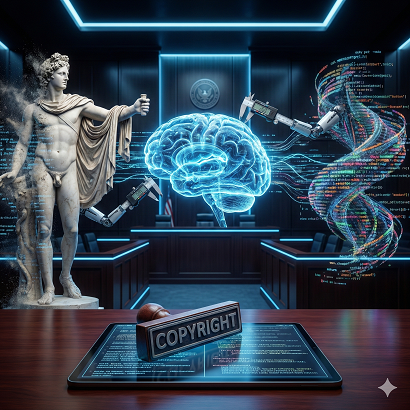

The Ownership Crisis: Navigating AI Intellectual Property Litigation in 2026
The era of “prompt and profit” has officially collided with the hammer of the law. In 2026, the biggest question in the boardroom isn’t “How fast can we scale with AI?” but “Do we actually own what we just made?”
As courts around the world issue landmark rulings on AI-generated content, AI Intellectual Property Litigation has become the new battlefield for corporate dominance. If your company uses generative models for code, marketing, or product design, you are sitting on a potential legal landmine.
The Myth of Automated Ownership
Many businesses still operate under the 2023 delusion that because they paid for a subscription, they own the output. In 2026, the law is clear: without a documented “Human-in-the-Loop” creative trail, your AI-generated patent or trademark might be considered Public Domain. Competitors can—and will—strip your brand of its unique assets if you haven’t secured the proper legal safeguards. This is where specialized AI IP attorneys are now essential.
1. The Cost of Inaction: Why “Wait and See” is a Multi-Million Dollar Mistake
Trust Signal: Financial Reality Check
The financial stakes of IP mismanagement in 2026 are staggering. We aren’t just talking about a “cease and desist” letter; we are talking about:
-
Training Data Clawbacks: If a court finds your proprietary LLM was trained on “dirty” (unlicensed) data, you may be forced to delete the entire model—costing years of R&D and millions in investment.
-
Statutory Damages: Penalties for AI-driven copyright infringement are reaching $150,000 per instance in the US, especially when AI is used to mimic a specific artist’s or writer’s “style” for commercial gain.
-
Injunctions on Product Launches: Imagine spending $10M on a campaign only to have it pulled 24 hours before launch due to a trademark conflict with an AI-generated logo.
2. Sector-Specific Risks: Software, Design, and Pharma
Trust Signal: Industry Expertise
-
SaaS & Software: If your AI-assisted code includes fragments of “Copyleft” or GPL-licensed data without your knowledge, your entire proprietary software suite could be legally forced into the open-source domain.
-
Biotech & Pharma: AI-discovered drug molecules are the new gold rush. However, if the AI’s “contribution” outweighs the human’s, the patentability of the $2B drug is currently under extreme legal scrutiny.
-
Media Agencies: The use of “Digital Twins” of actors or influencers without explicit “Synthetic Rights” contracts is the #1 cause of litigation in the entertainment sector this year.
3. The 2026 AI IP Compliance Checklist: Protect Your Assets
Trust Signal: Actionable Authority
To survive a 2026 IP audit and lower your litigation risk, your firm must implement the following:
-
[ ] Chain of Provenance Logs: Are you maintaining a time-stamped log of the human prompts and edits that led to a “final” creative output?
-
[ ] Clean-Room Training Verification: Have you audited your third-party AI vendors to ensure their models were trained on 100% licensed data?
-
[ ] AI-Output Registry: Are you registering your high-value assets with the copyright office specifically noting the “Human-AI Collaboration” ratio?
-
[ ] Vendor Indemnity Clauses: Do your contracts with AI software providers include a “Full Indemnification” clause for IP infringement?
Conclusion: Securing the Future of Human Creativity
In 2026, the most valuable asset your company owns isn’t your data—it’s your legal right to use it. AI Intellectual Property Litigation is the definitive hurdle of the decade. Companies that invest in “Clean AI” protocols and specialized legal counsel now will be the only ones standing when the dust settles on the global copyright wars.
WordPress & RankMath Optimization Tips:
-
Internal Link: Link to your previous post on “AI Deepfake Liability.”
-
External Link: Link to a 2026 update from the World Intellectual Property Organization (WIPO).
-
The “High-CPC” Placement: Place an ad unit right before the Compliance Checklist. This is where corporate decision-makers are most likely to click on “Consult an IP Attorney” ads.